How should your small business use AI marketing across its channels?
 by Elijah LeFavour, Chief AI Officer AI Advice

In brief: Use AI marketing for defined jobs across your search, ads, content, email, social and reporting. Keep a named person responsible for sources, customer information and publication. Start with one approved workflow, then review its output before adding another.
Short answer: organize your AI marketing around a specific task, an approved source and a human reviewer. Check facts before publication, follow the rules for each channel and separate visibility reports from customer outcomes.
You need a practical process before a longer software list. Use this guide to decide what to draft, what to measure and what your staff should approve. For this guide, I checked every statistic against its published source, from Google, NIST, the FTC and Mailchimp. Keep those source checks beside your working brief.
Where Should Your Small Business Start With AI Marketing?

Choose a repeatable task with a clear final output, such as a service page draft or an email awaiting approval. Write down the inputs your employee needs before starting. Then name the person who checks the finished work. Leave publication with an accountable reviewer until you have assessed the process against your own requirements.
NIST's generative AI profile describes confabulation as generative AI confidently presenting erroneous or false content. It recommends documented fact-checking, especially when information comes from multiple or unknown sources. Give your reviewer the original reference, the draft and a place to record corrections. Treat fluent wording as something to inspect, with every business claim checked against your approved information.
My advice: choose one service and one audience for your first workflow. Use a real customer question already recorded by your staff, with personal details removed from the working example. Write the answer your business is prepared to confirm as accurate. Then use the checklist below to define the draft and approval process.
- Name your intended reader and the question the content should answer.
- Supply approved service details, source links and brand voice rules.
- Assign your factual reviewer and publication approver.
- Record corrections before reusing your instructions.
Build your plan around the work, then choose a product. Our 25-tool marketing comparison groups verified capabilities by job. Use our agency selection guide when you want a provider to explain account access and review responsibilities. Compare each proposed service with the same written brief.
What Should You Do for Search and AI Visibility?

Google describes AI Overviews as helping people understand complicated topics and explore links for more information. It describes AI Mode as useful for deeper exploration, reasoning and complex comparisons. Start your website review with the questions customers ask before contacting you. Give each page a clear purpose and check its statements against your current services.
Google treats optimization for generative AI search as SEO. Its terminology guide explains AEO as answer engine optimization and GEO as generative engine optimization, terms for work focused on visibility in AI search experiences. Use those definitions when reviewing your provider's proposal. Ask for the pages, corrections and measurements behind each term.
For eligibility as a supporting link in Google's AI features, your page must be indexed and eligible to appear with a snippet. Google's documentation says meeting its requirements does not ensure crawling, indexing or serving. It also says new AI text files or extra structured data are unnecessary for these features. Ask for evidence of the proposed technical requirement before approving additional work.
Google lists matching structured data to visible text and keeping Business Profile and Merchant Center information current among relevant SEO fundamentals. Its local search guidance says businesses with complete, accurate information are more likely to appear in local search results. Check your service descriptions, location details and business information for accuracy. Record the corrections without assuming a particular position or citation follows.
How Should You Use AI in Ads and Reporting?

Google Ads AI Max is an optimization layer within existing Search campaigns, rather than a separate campaign type. Its search term matching uses broad match, asset-based technology and landing page-based technology to optimize campaign reach. Review your existing campaign before discussing the feature. Ask whoever manages it to identify the relevant settings and explain the proposed change in plain language.
In Performance Max text customization, Google AI generates headlines and descriptions from landing page content, the domain and current ads. Check those source materials before reviewing generated wording. Confirm your service names and claims agree across the draft and destination page. Keep your approval focused on what the business offers, with unsupported statements removed before use.
Google's Performance Max guidance recommends correctly configuring conversion tracking and adding relevant conversion actions as campaign goals. Write down which customer actions your business wants to measure before assessing an automated campaign. Ask for a demonstration of the selected goals and their definitions. Keep the approved definitions beside your reporting notes so everyone reviews the same activity.
Your search report needs its own explanation. Google includes traffic from AI Overviews and AI Mode within overall Search Console traffic under the Performance report's Web search type. Label the source and scope when you review those totals. Do not present the combined Web report as a separate count of AI-feature visits.
Google Analytics automated insights detects unusual changes or emerging trends and notifies users automatically. Use those notifications as prompts for your review, then inspect the relevant dates and underlying records. Separate the observation from your proposed explanation. Record what you checked before deciding whether to revise a campaign, a page or your measurement setup.
| Reporting source | Documented scope | Your review |
|---|---|---|
| Search Console Web reporting | Overall search traffic includes AI Overviews and AI Mode | Keep combined traffic totals clearly labeled |
| Google Analytics automated insights | Unusual changes or emerging trends in data | Inspect the underlying records before explaining a change |
What Stays Human in Content, Images and Social Posts?

Google says AI-generated content should be manually fact-checked and reviewed for accuracy and trustworthiness before publication. Apply this to your service descriptions and customer-facing explanations. Ask a staff member familiar with the service to verify the draft against approved information. Give the final approver a clear record of corrections, with unresolved claims held out of publication.
For social work, Buffer AI Assistant helps generate ideas, repurpose existing posts and summarize long content into short posts. Start with your approved service explanation, then ask for a version suited to the intended post. Compare every factual statement with the original before publishing. Review images, captions and the linked page together so your final message stays consistent.
Google defines scaled content abuse as generating many pages primarily to manipulate rankings rather than help users, regardless of how the content is created. Judge your proposed content by the customer question it answers and the information it adds. Remove repeated drafts without a distinct purpose. Keep a written reason for publishing each page instead of using page count as your objective.
Google's content guidance suggests considering AI or automation disclosures when readers would reasonably expect them. Review how your content was produced and whether an explanation would help the reader understand it. Keep this contextual guidance separate from advertising identification in email. Do not turn Google's recommendation into a universal labeling requirement for every edited sentence.
The FTC's consumer review rule addresses reviews or testimonials attributed to nonexistent people, including AI-generated fake reviews. It also prohibits incentives conditioned on a review expressing a particular positive or negative sentiment. Keep your review requests neutral and use genuine customer experiences. Do not ask a drafting tool to invent a customer, an endorsement or a result.
How Do You Review AI Email Before Sending?

Mailchimp Write with AI can help write marketing messages for your contacts. Prepare the audience, purpose and approved service information before asking for a draft. Keep your intended action clear, then review the wording against the material supplied. Approve the message only after checking the final subject line, sender details and required recipient information.
The FTC's CAN-SPAM guide says commercial email headers must accurately identify the initiating person or business, and subject lines must reflect the message. It also requires clear advertising identification and a valid physical postal address. Check those elements in your final message. Treat the address and sender review as part of approval, alongside the factual content.
Commercial email must clearly explain how recipients opt out of future marketing email. The mechanism must work for at least 30 days after sending, and opt-out requests must be honored within 10 business days. Keep both periods in your sending checklist. Assign someone to review the handling of requests before approving another campaign.
The FTC guide makes no exception for business-to-business commercial email, and hiring another company does not remove your legal responsibility. Separately, Mailchimp requires permission under its Terms of Use. Check the platform requirement alongside the FTC requirements. Ask your provider to show how your contact list, message review and opt-out handling fit the intended send.
How Does Spectral Vision Support Your AI Marketing?
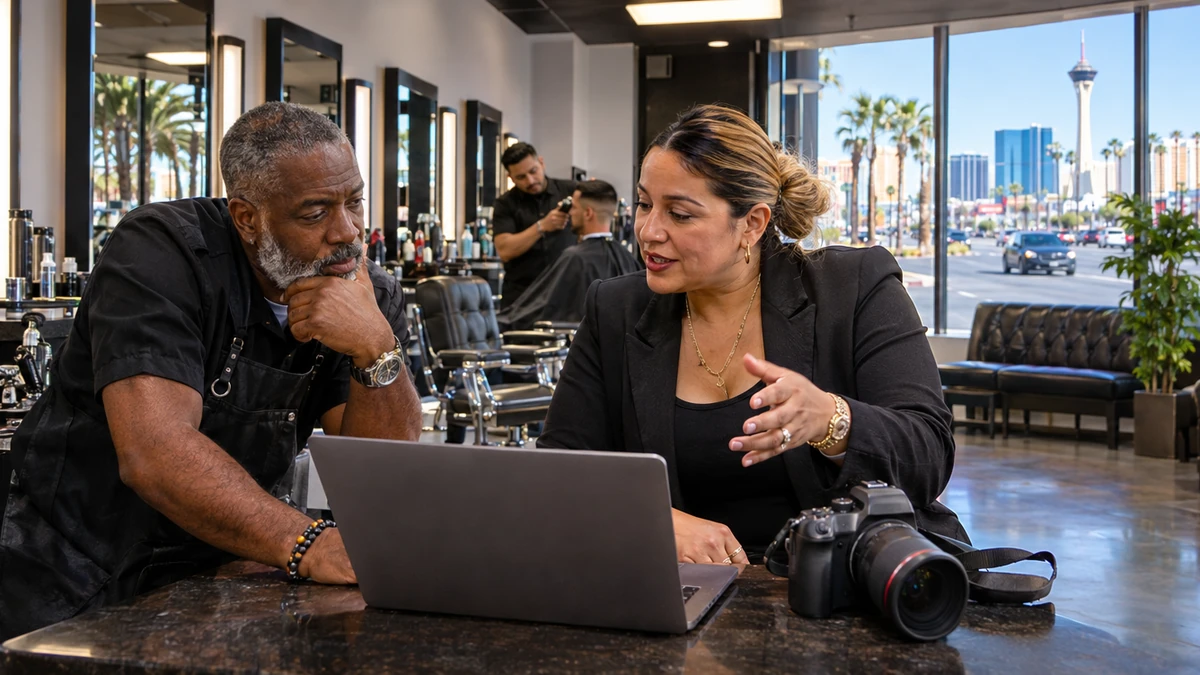
Spectral Vision has helped Las Vegas businesses grow since 2018. We work from five offices across the Las Vegas valley. Our AI marketing services in Las Vegas include AI-written emails, reports and social posts trained on your existing writing and brand voice rules, approved by you before they go live.
We use AI to manage your Google Ads through a search-term audit, campaign restructure and conversion tracking rebuilt. Your service includes weekly bid and budget tuning, monthly creative refresh and a live reporting dashboard you log into. We optimize your website for ChatGPT, Claude and Gemini in addition to Google. Our services also include AI-powered web design and local SEO.
AI Marketing: Your Questions Answered
Should I start AI marketing across every channel?
Start with one task and a named reviewer. Define your source material, final output and approval step before expanding the work. Use the same checks when adding another channel.
Does AI content need human review?
Google calls for manual factual review before publication. Give your reviewer the original sources and approved business details. Record corrections before approving the final draft.
Do I need new AI files for Google Search?
Google says new AI text files are unnecessary for its AI search features. Your page still needs to meet the documented eligibility requirements. Eligibility does not ensure selection.
Should I label every AI-assisted sentence?
Google suggests considering disclosure where readers would reasonably expect it. Review your content's production process and the explanation a reader needs. Keep this decision separate from email advertising identification.
Does an agency take over my email compliance responsibility?
Hiring another company does not remove your commercial email responsibility. Review sender accuracy, message requirements and opt-out handling with the provider. Keep Mailchimp's permission requirement separate from the federal guide.
Does Search Console separate AI-feature traffic here?
Google reports AI Overviews and AI Mode traffic within the Performance report's Web search type. Treat your Web totals as the documented combined reporting scope. Label any separate monitoring report with its own method.
Discuss your marketing workflow with our Las Vegas AI team. Bring your service list, current content and reporting questions. Identify the person who approves your customer-facing material.
Like this article? Add Spectral Vision as a preferred source, and you are more likely to see our articles in Google's Top Stories.